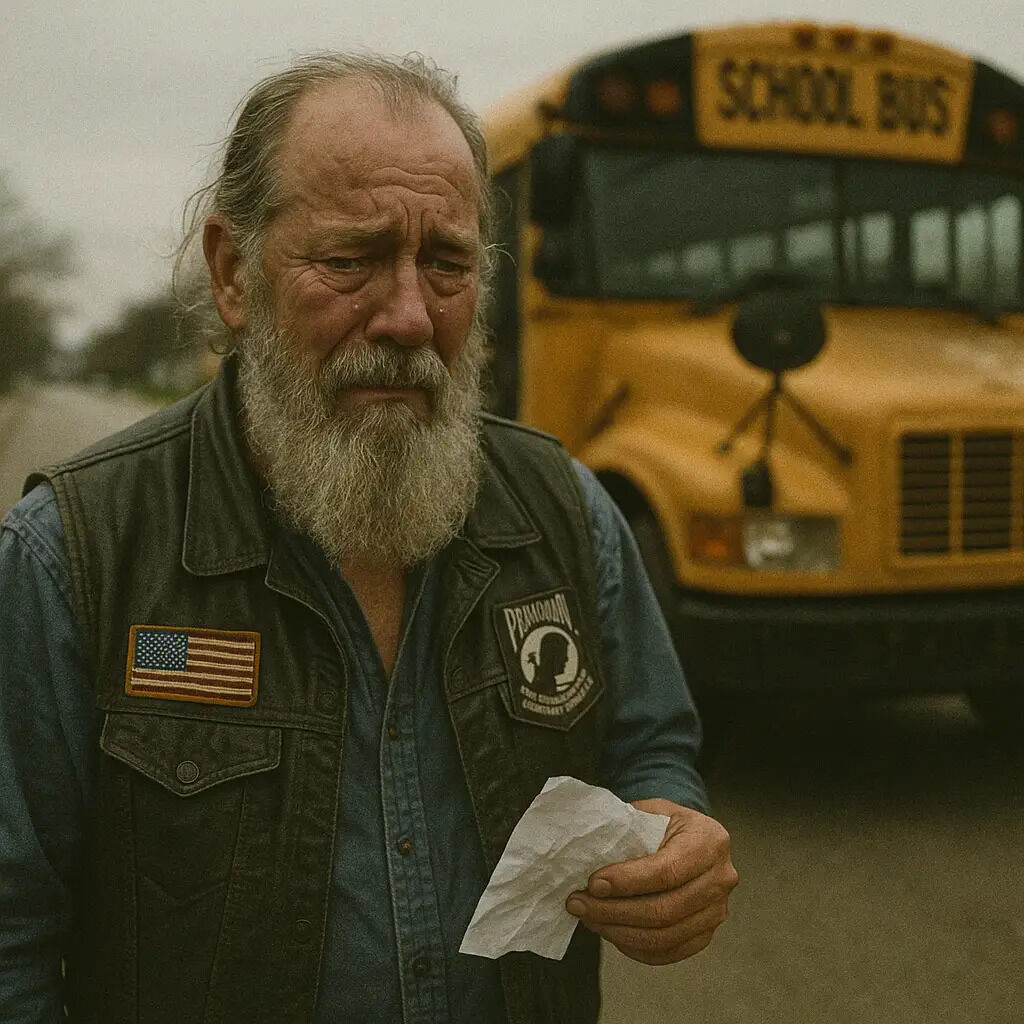
“Those are my terms. The school board wanted to throw me away based on how I look, who I ride with. Now they need to face those men, shake their hands, and recognize them as the veterans, businessmen, and fathers they are.”
Emma finished writing and looked up at me. “You’re asking them to confront their prejudice directly.”
“Exactly. It won’t change overnight, but it’s a start.” I sipped my coffee. “Will you help me? Make sure they understand these aren’t negotiable?”
“I’d be honored, Mr. Ray.” She hesitated. “Can I ask you something personal?”
I nodded.
“Why did you start riding? What made you choose motorcycles?”
It was a question I rarely answered, but Emma had earned my trust.
“My brother, Mike, was a rider before Vietnam. Had a beautiful Triumph he restored himself. When he didn’t come home…” I paused, the old grief still sharp. “When they declared him MIA, his bike came to me. I didn’t touch it for nearly a year. Couldn’t bring myself to.
“Then one night, I had a dream that Mike was yelling at me. ‘It’s not a shrine, Ray! It’s meant to be ridden!’ Next morning, I got it running. Taught myself to ride it. And when I did…” I shook my head, remembering. “It was the closest I’ve felt to him since he disappeared. Like somehow, on that bike, I could still talk to him.”
Emma’s eyes glistened. “That’s beautiful.”
“Motorcycles connect us to what matters,” I said simply. “To the road beneath us. To the world around us. To each other. Nothing between you and everything that’s real.” I smiled faintly. “Hard to explain to people who’ve never felt it.”
“Maybe that’s what they need to understand,” Emma said thoughtfully. “Not just that bikers aren’t dangerous, but what riding actually means to you.”
“Maybe,” I agreed, though I doubted most would ever truly get it. “But at minimum, they need to learn that you can’t judge a man by what he rides or what patches he wears. You judge him by how he treats others. By whether he shows up when he’s needed. By whether he leaves things better than he found them.”
My return to Bus 17 the next morning caused quite a stir. I arrived on the Harley, parked it prominently beside the bus, and conducted my pre-trip inspection wearing my regular uniform but with one addition—my leather vest over the top.
The children were ecstatic to see me. Even the teenagers, usually too cool to show emotion, seemed relieved. Little Annie Phillips, a first-grader with perpetually untied shoelaces, threw her arms around my waist.
“Mr. Ray! You came back! And you brought your motorcycle!”
I helped her up the steps, tying her shoes as I’d done a hundred times before. “I sure did, sweetheart. What do you think of it?”
“It’s pretty,” she declared. “Can I ride it someday?”
“When you’re much older,” I promised. “And only with your parents’ permission.”
Throughout the route, I was greeted with waves from parents at bus stops—some apologetic, others supportive, a few still wary. Mrs. Westfield wasn’t at her stop. Her son, Derek, climbed aboard without looking at me, his face crimson with embarrassment.
As he passed, I said quietly, “Your mom did what she thought was right, Derek. No hard feelings.”
The boy paused, surprised. “Really?”
“Really,” I confirmed. “Sometimes people make mistakes because they’re scared. Doesn’t make them bad people.”
He seemed to consider this, then nodded and continued to his seat.
The next three weeks passed in a blur of morning and afternoon routes, paperwork for my retirement, and planning for the ceremony. Emma was true to her word, ensuring the school board accepted all my conditions, though not without resistance to the idea of leather-clad bikers attending an official school function.
On my final day as a bus driver, I was surprised to find parents waiting at every stop, many holding cards and small gifts. Mrs. Chen, whose three children I’d driven for over a decade, pressed a tin of homemade cookies into my hands.
“We will miss you, Mr. Ray,” she said, her accent thick with emotion. “Forty-two years. Three generations of Chens. All safe because of you.”
At another stop, Mr. Grayson, a tough construction worker who rarely spoke, awkwardly handed me an envelope.
“Gift card,” he mumbled. “For that motorcycle parts place you mentioned once. Thought maybe… you know. For your retirement.”
By the time I completed my final route and pulled into the school lot for the last time, my emotions were raw. The bus—empty now, the children all delivered home safely one last time—seemed to echo with four decades of young voices, laughter, occasional tears, countless conversations.
I sat at the wheel for a long moment, hands still resting where they’d been positioned for countless miles. Then I completed my final post-trip inspection, signed my paperwork, and handed in my keys to Transportation Director Miller, who’d been a skinny twelve-year-old on my route when I first started driving.
“Gonna be strange not seeing you behind the wheel, Ray,” Miller said, gripping my hand firmly. “Don’t be a stranger, you hear? Shop guys said they’re keeping your parking spot open. You can bring the Harley by anytime.”
“I appreciate that, Ken.” I looked around the garage one last time. “Gonna miss this place.”
“Place is gonna miss you more,” he replied. “See you tomorrow at the ceremony?”
I nodded. “Me and about twenty of my closest friends.”
The retirement ceremony was scheduled for 2 PM in the school gymnasium. I arrived at 1:30, pulling into the lot alongside my club brothers—twenty-four motorcycles in formation, engines thundering in unison, chrome gleaming in the spring sunshine.
We parked in a neat line, a deliberate show of discipline and order. My brothers wore their full club colors, patches displayed proudly, but had agreed to leave their more intimidating accessories behind. No skull rings. No heavy chains. Nothing that might reinforce the stereotypes we were trying to break.
Tommy Wilkins rode with us, though he wasn’t a club member. So did three other veterans I’d met through riding, men whose lives had been changed by the brotherhood of the road.
As we walked toward the gymnasium, helmets under arms, I noticed people staring—teachers, parents, administrators gathered for the event. Some looked nervous. Others curious. A few openly hostile.
Principal Hargrove met us at the entrance, visibly tense despite his attempt at a welcoming smile.
“Ray,” he said, shaking my hand. “And these must be your… club members.”
“Brothers,” I corrected firmly. “John, meet Doug Phillips. Twenty-seven years as a state trooper before retiring. And this is Alan Whitman, runs the hardware store downtown. Michael Chen, surgeon at County General. Jeff Davis, pastor at First Methodist.”
One by one, I introduced my brothers—ordinary men with extraordinary bonds, united by our love of riding and our commitment to each other. With each introduction, I watched Hargrove’s expression shift from wariness to confusion to the beginnings of understanding.
Inside, the gymnasium was decorated with banners and photos from my years of service. A display table held letters from former students, some now in their fifties with grandchildren of their own. A cake decorated with a yellow school bus sat on another table.
As we entered, the crowd turned to stare. A murmur rippled through the assembled parents and teachers. My brothers remained dignified, respectful, standing tall in their leather as we made our way to the seats reserved for us in the front row.
The ceremony began with Hargrove offering a carefully worded speech about my years of service, making no mention of the suspension or the controversy. Several parents spoke about their children’s experiences on my bus. A video played showing students from every grade holding thank-you signs.
Then came the surprise. Emma Castillo stepped to the microphone.
“Many of you know me as the journalism student who wrote about Mr. Ray’s suspension,” she began. “What you may not know is that twelve years ago, I was a terrified first-grader too afraid to get on the school bus. For weeks, my mother had to drive me to school because I was convinced the bus would crash.”
Emma looked directly at me, smiling. “Then one day, Mr. Ray came to our house. Sat with me at our kitchen table. Showed me pictures of all the children he’d driven safely to school for decades. Promised me that if I ever got scared on his bus, I could sit right behind him, and he’d make sure I was okay.”
Her voice wavered slightly. “I rode his bus from that day until I graduated high school. And in all those years, I never once felt afraid. Because Mr. Ray kept his promise—not just to me, but to every child who climbed those steps.”
She gestured to the back of the gymnasium, where the doors suddenly opened. In walked a procession of people—former students of all ages, from teenagers to middle-aged adults. Each carried a single rose.
“These are just a few of the thousands of children Mr. Ray has driven safely over his forty-two-year career,” Emma explained. “They’re here to honor the man, not just the bus driver. To recognize that sometimes, heroes don’t wear capes or uniforms—sometimes, they wear leather vests and ride motorcycles.”
One by one, my former students approached, placing their roses in a growing pile on the stage. Some whispered thanks. Others shared quick stories of kindnesses I’d long forgotten—the time I’d given Jason Miller my gloves when he forgot his on a freezing day; the afternoon I’d waited with Maria Sanchez for two hours when her mother’s car broke down and she had no way to get home; the mornings I’d kept the bus warm while Stevie Washington finished his homework because his family couldn’t afford to heat their house properly.
As the roses piled higher, I felt Margaret’s absence keenly. She should have been here to see this. She’d been the one who encouraged me to take the bus driver job all those years ago, when the factory closed and jobs were scarce.
“You’re good with kids, Ray,” she’d said. “Patient. Kind. They’ll respond to that.”
She’d been right, as she so often was.
When the last rose was placed, Tommy Wilkins took the microphone. His voice, once shaky with PTSD, was now strong and clear.
“Many of you know me as Coach Wilkins from the high school,” he began. “What you may not know is that fifteen years ago, I came home from war broken in ways you couldn’t see. Mr. Ray found me in that darkness and led me back to light—not with words, but with the simple gift of brotherhood on the open road.”
Tommy looked at me, then at my club brothers, then at Mrs. Westfield, who sat rigidly in the third row.
“You see those men in leather? The ones some of you were afraid to have in your school? Eight of them are veterans like me. Five more are fathers of children in this district. All of them have contributed thousands of hours and dollars to charities that help this community.”
He gestured to our club patches. “Those symbols that frightened you? They represent honor, loyalty, and service—the same values you want to teach your children.”
Tommy’s voice dropped lower, intense. “Before you judge a man for the machine he rides or the clothes he wears, ask yourself this: Has he shown up when needed? Has he served others before himself? Has he made this world better for having been in it? Because Ray Mercer has done all of those things, not despite being a biker, but partly because of it.”
The gymnasium fell silent. I watched Mrs. Westfield dab at her eyes with a tissue. Beside her, her husband looked thoughtful, troubled even.
Principal Hargrove returned to the microphone, clearly moved. “Ray, on behalf of Riverdale School District, I want to present you with this plaque commemorating your forty-two years of exemplary service.” He paused, then added, “And I want to offer a personal apology for recent events. We judged unfairly, and for that, I am deeply sorry.”
I stood to accept the plaque, taking the microphone for the first time.
“Forty-two years ago,” I began, “I took this job because I needed the work. Stayed because I found something I didn’t expect—purpose. Every child who climbed those steps was entrusted to my care, if only for a little while. I never took that lightly.”
I looked out at the faces watching me—parents, teachers, students past and present. My club brothers sitting proudly in their leather.
“There’s been a lot of talk about my motorcycle, about my club. Some of you wondered how a man could be both a school bus driver and a biker. The truth is, both came from the same place inside me—a desire for freedom, yes, but also connection. Community.”
I gestured to my brothers. “These men have been my support through losing my wife, through hard times you can’t imagine. Just as I’ve been a support to your children on difficult days. Different kinds of family, but family nonetheless.”
I held up the plaque. “I’m grateful for this recognition. But the real reward has been watching your children grow up, year after year. Seeing them become the people they were meant to be. That’s a gift you all gave me, whether you realized it or not.”
I cleared my throat, fighting unexpected emotion. “Tomorrow morning, Bus 17 will run its route with a new driver. Treat them with the same trust you eventually gave to me. And if you see an old man on a Harley on the back roads some Sunday morning, give him a wave. He’ll be remembering forty-two years of morning pickups and afternoon drop-offs, and feeling grateful for every single one.”
The ceremony ended with cake and punch, handshakes and hugs. One by one, parents who had signed Mrs. Westfield’s petition approached me and my club brothers, awkward but sincere in their apologies.
Mrs. Westfield herself came last, her husband beside her. She looked different somehow—smaller, less certain of her righteousness.
“Mr. Mercer,” she began formally, “I owe you an apology. I made assumptions based on fear, not facts.”
“Thank you, Mrs. Westfield,” I said, accepting her outstretched hand. “I appreciate that.”
Her husband stepped forward. “I should tell you… I used to ride. Years ago, before Derek was born. Sold my bike when we started a family because…” he glanced at his wife, “well, because it seemed like the responsible thing to do.”
“Nothing wrong with making choices for your family,” I assured him.
“No, but there’s something wrong with judging others for making different choices.” He hesitated, then added quietly, “I still miss it sometimes. The riding.”
I smiled. “They make some pretty safe bikes these days. Never too late to start again.”
As they walked away, I saw him place his hand on the small of his wife’s back, leaning to whisper something in her ear. She looked surprised, then thoughtful.
Emma approached as the crowd began to disperse. “Mission accomplished, Mr. Ray. You changed some minds today.”
“Maybe a few,” I agreed. “It’s a start.”
“What will you do now? With retirement?”
I looked over at my brothers, waiting patiently by the exit. Tommy among them, laughing at something Doug had said.
“Ride,” I said simply. “See some of those places I’ve always wanted to visit. Maybe organize a few charity runs.”
Emma smiled. “Can I interview you again? For a follow-up piece? ‘Life After the Last Stop’ or something like that?”
“I’d like that.” I placed my hand on her shoulder. “You know, your article made a difference. Made people think.”
“I just told the truth,” she said with a shrug. “Sometimes that’s all it takes.”
As we walked toward the exit together, I felt a lightness I hadn’t experienced in years. The indignity of the suspension would always be there, a scar on an otherwise unblemished career. But today had healed something important—not just for me, but perhaps for others who had been quick to judge based on appearances.
Outside, my brothers waited beside their bikes. The sun was setting, casting long shadows across the school parking lot where I’d parked my car for forty-two years. Tomorrow, someone else’s vehicle would occupy that space.
“Ready to ride, Ray?” Doug called, already straddling his Electra Glide.
I looked back at the school one last time, then at the men waiting for me—my other family, the one that had sustained me through grief and joy, through Margaret’s illness and death, through lonely holidays and empty rooms.
“Ready,” I confirmed, pulling on my helmet.
We fired up our engines in unison, the combined rumble echoing across the nearly empty parking lot. I took the lead position, a place of honor they’d insisted on for my retirement day.
As we pulled away from Riverdale Elementary for the last time, I caught a glimpse of Principal Hargrove watching from the doorway. I raised my hand in a final salute—not to him specifically, but to the four decades of memories, to the countless children who had trusted me with their safety, to the career that had given my life meaning when I needed it most.
Then I faced forward, leaning into the first curve of the road that would take us home.
The wind pressed against my chest, cool and cleansing. Ahead lay open road. Behind me rode brothers who understood without words. And somewhere beyond this earthly journey, I liked to think Margaret was watching, smiling at the old bus driver who had finally, truly, completed his route.
